Showing posts with label web. Show all posts

Facebook Messenger just beat Snapchat at its own game-- TECHNOLOGY HANDLER


Your Facebook Messenger conversations are about to undergo a big visual upgrade and it even has new features that aren’t available on Snapchat just yet.
“Messenger is becoming more real-time and more visual,” explained Stan Chudnovsky, head of product for Facebook Messenger, who noted that emoji and the in-app camera are outpacing overall text message growth. “We looked at that and figured, ‘Why don’t we go all the way?’”
Meet the latest Messenger update, which begins rolling out to smartphones today. It’s mostly been in the hands of employees and influencers designing stickers, but TechRadar was able to spend an afternoon playing around with the new app at Facebook’s Los Angeles office.
There’s a prominent camera button right inside the otherwise familiar iOS and Android chat app, making it easy to snap a photo or record a video. You can then add the sort of stickers, emoji, text, drawings and special effects that Snapchat has popularized. It’s almost all here.

One way Messenger beats Snapchat

Here is what’s really different: Facebook Messenger allows you to reverse the order of operations. Start with a “blank” canvas by throwing the same art into the camera viewfinder, then snap your photo when every sticker is lined up just how you like it.
You can perfectly position yourself behind all of that visual flair in a way that’s more efficient and fun than it is on Snapchat right now. Sure, Snap debuted four new features for its app this week, but it doesn’t have this one – and it’s important.
I posed in front of this classically drawn white coffee mug sticker, for example, having already placed it where I wanted it in the camera first. It was much easier to then arrange myself around the perfectly placed mug, and it allowed me to focus on making a stupid face. This is a better way of telling my friends “I’m working today and require coffee this very minute.”
Then I set up another photo by effortlessly ducking my head underneath a bunch of light rays (no, not stink lines, thanks), telling friends I was at Facebook LA today. The Messenger team intended to make these visual messages expressive and fast, and this does just that.

Brings AOL Instant Messenger ‘Away Messages’ into 2017

Remember AOL Instant Messenger’s away messages? Facebook is bringing that idea back with today’s update thanks to its own unique take on expiring visual messages.
“That was how I’d look at my buddy list,” said Peter Martinazzi, Director of Product Management for Facebook Messenger, recalling way too many sad and lyric-filled AIM away messages. “I’d see what my friends were up to at the time, and then I would message them based on that. This was a really big part of the chat experience.”
Today’s Messenger update is finally bringing a chat status that’s separate from your Facebook status – said to be a long-awaited feature for users – and it too is undergoing a visual retooling. It’s called ‘Your Story’ and it answers that same ‘what are you up to?’ question by allowing you to string together your visually enhanced messages for your friends to see.‘
Your Stories’ expire after 24 hours, just like Snapchat and Instagram’s similar ‘Stories,’ but this one is meant to be seen by your friends. That’s why the AIM away message analogy actually works. In fact, Messenger’s version of Stories appear at the top of the main chat menu, but it’s mainly populated with people you interact with – not every single friend. Even if you reach Facebook’s 5,000 friends limit, the most people that will see ever your stories is 500.
Update: The status message portion of Messenger of the update won't launch everywhere right away, but Facebook said it's rolling out over time.

Facebook’s two big advantages

“It’s less about the volume of people, and more about the right people – the ones you’re already talking to and those conversations get better,” noted Martinazzi, explaining how Messenger’s Stories are different from those seen on Snapchat.
Facebook knows who your friends are more than any other service. ‘Your Stories’ is sorted by the friends you interact with on Messenger and, to a smaller extent, Facebook. That’s currently a huge advantage for the service over something like Snapchat.
There’s also the fact that Messenger is a more straightforward chat app with a familiar user interface (UI). In addition to being used by one billion people a month, Messenger is now seeing hundreds of millions of users everyday, according to the Facebook team.
Messenger is in more hands and the app design is easier to use for non-millennials. That means it has a better chance of taking snaps mainstream. If I ever intend to pry my parents off of SMS and iMessages, I can introduced them to Messenger. I can’t imagine teaching them Snapchat.

For those missing the point: the birthday card analogy

Not everyone knows why they would want to create a visual message to get their point across, but Facebook’s Peter Martinazzi had a great analogy for when it works, likening it to a receiving a personalized birthday card.
“I actually don’t buy birthday cards,” admitted Martinazzi. “But my aunt still buys me birthday cards and when she does, she could just write me a message that says ‘Happy Birthday’ but she goes and picks out the perfect card for me.
“That helps her get her message across,” said Martinazzi. “Right now, the way emoji works, it’s like giving that blank card.
“With the camera, you can kind of put your name behind it.”

6 Best Free SEO Tools for Startups -- TECHNOLOGY HANDLER

You can use these tools for enhancing your strategies until you garner enough revenue to move on to bigger and better tools. Here is a list of the best free tools for SEO startups…
Moz
Moz has a whole suite of SEO tools that you can try . These tools include keyword tracking, ranking monitoring, on-page optimizations, and link tracking, just to name a few.The users can manage and update business listings across the web with a single platform.
 MergeWords
Merge words is fast and easy to use for domain registrations, Google Adwords, whatever. Use MergeWords to research keywords for rankings and domains, and queries for link building. It’s an efficient tool for organizing all search information into data that you can use to plan your strategies.
 Buffer
With the use of Buffer software, scheduling all of your social media content interactions is simple. It has a comprehensive content builder that enables filling in SEO-optimized content and setting up a publishing time frame to keep your campaign on track. It’s one of the best tools for staying ahead of the social game.
 Google Tools
Google has an arsenal of tools that you should at least check out when it comes to search engine optimization. Google Webmaster Tools, Google Analytics, Google Adwords Keyword Planner, Google Trends, PageSpeed Insights, and more can all be utilized to test the success of all SEO-related content and strategies. The best part is, most of these tools are entirely free for the basic versions.
 Screaming Frog
This free tool is legendary for its ability to “spider crawl” through websites, links, images, code, and apps in order to collect useful data for maintaining your website.  You’ll be able to fix many of the errors that would otherwise hurt your rankings, such as image errors, incomplete meta tags, or copied content. Screaming Frog is also very useful for spying on competition and receiving reports on inbound and outbound links.
 SimilarWeb
It is an excellent tool for gathering insightful data about your websites, customers, or even competitors. It can also be used to define a target audience, pick up on branding cues, report on traffic sources, and track other helpful metrics. Though there are other free tools that do the same thing, this apparatus is particularly useful because it delivers all the information in easy-to-read graphs, which simplifies the process.
                                                                    source: pcquest

Facebook tests 'Express Wifi' in India -- TECHNOLOGY HANDLER


Months after it received flak for allegedly violating net neutrality with Free Basics, social networking giant Facebook is now testing a new model for public Wi-Fi deployments for offering quality internet access in rural parts of the country.

According to Facebook's Internet.org page, the company's "Express Wifi" is live in India and it is "working with carriers, internet service providers and local entrepreneurs to help expand connectivity to underserved locations around the world".

"...are expanding to other regions soon," it added.

However, Facebook did not indicate if the Wi-Fi will provide limited access of a few websites, like its Free Basics, or provide full access. Express Wifi empowers local entrepreneurs to help provide quality internet access to their neighbours and make a steady income, it further said.

"Working with local internet service providers or mobile operators, they are able to use software provided by Facebook to connect their communities," it said.

Facebook is experimenting with products like laser drones to enhance internet connectivity for users across the world.

When contacted, a Facebook spokesperson confirmed that the company is currently working with internet service providers to test 'Express Wi-Fi' with public Wi-Fi deployments in multiple pilot sites.

"This solution empowers ISPs, operators and local entrepreneur retailers to offer quality Internet access to their village, town or region," the spokesperson said.

However, the spokesperson did not comment on the locations or the names of the partners in the project. The spokesperson said Express Wi-Fi customers can purchase fast, reliable and affordable data packs via digital vouchers to access the Internet on the Express Wi-Fi network.


"We focus on building a sustainable economic model for all stakeholders involved, so that local retailer entrepreneurs, ISPs, operators and Facebook can continue to invest in and operate lasting connectivity. We believe a sustainable economic model is the one which can scale to bring all of India online," the spokesperson said. 


The US-based company had pulled the plug on its controversy- ridden 'Free Basics programme' in India in February this year after telecom regulator Trai barred operators from charging discriminatory rates for Internet access based on content.


Launched in 2014, Facebook continues to run the programme across many countries. The service was launched in India in partnership with Reliance Communications as Internet.org.


The service -- which was later rebranded as Free Basics -- aimed at providing basic Internet access to people in partnership with telecom operators. However, critics slammed the service saying it violated the principle of net neutrality that advocates equal treatment of all internet traffic.

5 Open Source Developers Tools For Web Development - TECHNOLOGY HANDLER

Here is a list of some open source tools for your web Development Systems.
1. ASP.NET: ASP.NET is an open source web framework for building modern web applications and services. With ASP.NET you can quickly create websites based on HTML, CSS, and JavaScript, scale them to millions of users and easily add more complex capabilities like Web APIs, forms over data or real time communications.
Download: http://www.asp.net/downloads
Operating System: Windows, Linux, OS X.
2. Bluefish : Bluefish is a powerful editor targeted towards programmers and web developers, with many options to write websites, scripts and programming code. Bluefish supports many programming and markup languages.
Download: https://sourceforge.net/projects/bluefish/
Operating System: Windows, Linux, OS X
3. Bootstrap: Bootstrap is the most popular HTML, CSS, and JS framework for developing responsive, mobile first projects on the web. Bootstrap makes front-end web development faster and easier. It’s made for folks of all skill levels, devices of all shapes, and projects of all sizes.
Download: http://getbootstrap.com/
Operating System: OS Independent
4. Bower: Bower can manage components that contain HTML, CSS, JavaScript, fonts or even image files. Bower doesn’t concatenate or minify code or do anything else – it just installs the right versions of the packages you need and their dependencies. Bower works by fetching and installing packages from all over, taking care of hunting, finding, downloading, and saving the stuff you’re looking for
Download: https://github.com/bower/bower
Operating System: OS Independent
5. Brackets: Brackets is a lightweight, yet powerful, modern text editor. It blends visual tools into the editor so you get the right amount of help when you want it without getting in the way of your creative process.
Download: http://www.softpedia.com/get/Programming/File-Editors/Brackets.shtml
Operating System: OS Independent

LinkedIn is now officially blocked in Russia- Technology Handler


Amid a tense stand-off and attempt at negotiations, Russia’s communications regulator Roskomnadzor has started to enforce a proposed block of LinkedIn in the country, after the social network failed to transfer Russian user data to servers located in the country, violating a law instituted in Russia requiring all online sites to store personal data on national servers.
The order against LinkedIn was issued in a short statement on Roskomnadzor’s site (in Russian) — flagged to us by reader Ilya Pestov, CMO at Statsbot — that cited the original Moscow District Court decision from August to block LinkedIn, along with the more recent case from November 10, in a Moscow City Court, to uphold that decision.
LinkedIn has confirmed the block to us in a statement:
“LinkedIn’s vision is to create economic opportunity for the entire global workforce. We are starting to hear from members in Russia that they can no longer access LinkedIn,” said a spokesperson. “Roskomnadzor’s action to block LinkedIn denies access to the millions of members we have in Russia and the companies that use LinkedIn to grow their businesses. We remain interested in a meeting with Roskomnadzor to discuss their data localization request.”
The ban comes after LinkedIn — which is currently being acquired by Microsoft for $26.2 billion, although that deal is seeing some of its own regulatory hiccups — tried to meet with Russian regulators on Friday, November 11, in a last-minute attempt to hold off the ban, which will see ISPs in Russia forced to comply with the block in coming hours or else face heavy fines and potentially blocks of their own.
The statement they gave us last week, combined with what we know today, seems to imply that LinkedIn never got that meeting.
“LinkedIn’s vision is to create economic opportunity for the entire global workforce,” a spokesperson told TechCrunch last week. “The Russian court’s decision has the potential to deny access to LinkedIn for the millions of members we have in Russia and the companies that use LinkedIn to grow their businesses. We have on Friday (11 Nov) again requested a meeting with Roskomnadzor to discuss their data localization request and we understand they are reviewing this proposal at the present time.”
It’s not clear if LinkedIn hoped to buy more time to comply with the ruling, or if they were hoping to somehow negotiate an exception to the law. (We’ve asked, and will update if and when we get a reply.)
There is a precedent for LinkedIn choosing to comply and perhaps asking for more time. When LinkedIn launched in China, it did so by building essentially a completely separate site, with data hosted within the country, in order to meet similar regulatory requirements. Others that have done this include Evernote.


From what we understand, although there are a number of international sites accessible in Russia today, not all of them are hosting data within the country.
It’s not clear why LinkedIn — which has out of its 467 million users only 5 million registered in Russia — was targeted in this case. Some have speculated that it was a warning to bigger sites to be on their guard.
Russia has described its rule on localized servers as a way of protecting user’s personal data, although many dispute this reasoning, claiming that Russia simply wants an easier route to access that data for itself.
Data and the hacking of it is, in a way, shaping up to be the next cold war frontier. Russia has been implicated in a number of high-profile hacking cases, such as the recent breach of Democratic National Committee servers. Those investigations are still ongoing. Meanwhile, countries like the U.S. and U.K. are redoubling their efforts to build up their expertise and security both in response to the wave of breaches, but also perhaps to better arm themselves as aggressors.
Facebook and Twitter, both accessible in Russia, are among those that today appear still to keep their data housed out of Russia. Apple and Google reportedly have complied.
And, as is often the case with these blocks, if you are in the country and use a VPN service that essentially makes you look like you’re online in another country, you can continue to use LinkedIn and anything else that is or might get blocked.
                                          source: techcrunch

How to avoid getting conned by fake news sites

Here's how you can identify and avoid sites that just want to serve up ads next to outright falsehoods.
You don't need Socrates to tell you that some websites spin crazy, made-up yarns just so you'll click a link.

False information and fake news have been a problem on the internet almost since the beginning. The situation is so bad, one website, Snopes.com, is dedicated to debunking crazy internet tales and rumors that pop up like digital cockroaches.
The issue rose to prominence again with the election of Donald Trump, which critics say was aided by fake news reports that were rampant across social media, especially Facebook. CEO Mark Zuckerberg has called that notion "pretty crazy" but says his company is working to clamp down on bogus articles.
In the fervor over whether Facebook should do something to separate fiction from fact, you may have wondered how you could figure out whether an article is worth clicking on. Here's our advice on how to flag false stories that just want to take you for every click you're worth.

What is 'fake news?'

First of all, let's be clear: We're not talking about websites with paid journalists who fact-check their reporting and build their brands on accuracy. (Reputable companies have rules on fact-checking. CNET's reporters and reviewers are required to verify information and back it up with links to source material such as press releases, videos and websites.)
The issue is that legitimate news stories get mixed in with everything else on your Facebook "news" feed. That includes stories from websites that are posing as news sources to harvest your clicks. What's more, even if you click a link to a well-researched Wall Street Journal story, Facebook could show you related stories from sites that don't meet those same standards.
As CNET News Editor-in-Chief Connie Guglielmo pointed out, the problem here is that everything in social media is treated like news, with no distinctions.

How to flag fake news sites

The best tool at your disposal, of course, is common sense. No matter what your political bent, if a story serves only to reinforce your beliefs, it's best to be extra skeptical before sharing it.
If a report is purportedly based on other news stories, find the original source of the information. You might find some of the quotes are correct, but the rest may have been taken out of context or fabricated.
If the potentially false story you're reading doesn't link to an original source, well, that's a bad sign. Use a search engine to look for the keywords in the story to see if that "news" is being reported by any other outlets.
Some stories, intentionally or not, read like satire. If it sounds like it could be a headline on the Onion, it's best to double-check the story.
Also check the URL. If it has a strange ending, think twice about the story. An article claiming President Barack Obama banned the national anthem at US sporting events -- false, if you were wondering -- came from a website with the suffix ".com.de," which makes no sense.
No, this is not a real story.Photo by Screenshot by Laura Hautala/CNET
Finally, don't trust a photograph. If you see a compelling photo and are just itching to share the story behind it, try this first:
  • Take a screenshot of the photo, cropping out everything but the image itself.
  • Open up Google Images in your browser.
  • Drag the screenshot into the Google Images search field.
Google will tell you its best guess as to who or what is pictured and where the image originated.
I tried this on a black-and-white photo that ran with a meme about Susan B. Anthony. The photo showed a woman in a Victorian gown lying in the street as police and bystanders stood over her. It turned out the suffragist in the photo was Britain's Ada Wright, not Anthony.
Pro tip: You can do this with photos from dating and real estate websites too, and you might catch a scammer while you're at it!

More ways to flag fake news sites

Programmers have put their heads down to come up with tools that can flag unverified reports in your social-media feeds.

The plugin isn't available for download yet, but the students are enlisting help in finishing it, through an open-source project.For example, three students programmed a browser plugin that automatically evaluates stories linked in social media and highlights those that have been debunked elsewhere. The cute name for the plugin: FiB.
New York Magazine writer Brian Feldman programmed a plugin too -- it's not automated, but it checks articles against a list of known fake news sites put together by Merrimack College media professor Melissa Zimdars.

Who's writing this fake news?

According to a Buzzfeed story, young people in Macedonia created more than 100 pro-Trump websites to spread false news. The motive wasn't political; it was to make money off your clicks.
Maybe we should be glad they're not turning to cybercrime to capitalize on our collective naivete, like young people in other parts of Eastern Europe have done. Still, it's pretty strange to think that Macedonian website owners were gaming Google's or Facebook's ad programs to make money off fake-but-viral news stories.
Google and Facebook each said on Monday that they will ban fake news sites from using their respective ad-selling software.
Snopes also has a guide to fake news sites, some of which are political and some of which are simply purveyors of wild and wacky lies.
The election may be over, but there's still plenty of fake news to go around.
                                             source: cnet.com/news
Adds link to story about Friday night comments from Mark Zuckerberg.

Merchants throng to FreeCharge as digital payments surge


freecharge


The government’s recent demonetization action has spurred the digital payments sector in a massive way with sellers reaching out to FreeCharge in order to immediately sign up to start accepting digital payments.
In the last two days, FreeCharge has seen a 10X surge in the number of retail merchant sign-up queries, with most of the queries coming from grocery stores, pharmacies and food joints. The queries pertain to the sign-up process, documentation required to on-board, commercial arrangement etc.
In order to quickly enable the merchant on-boarding, FreeCharge has also started a drive asking its entire team to help the retail merchants in their proximity to sign-up as a merchant and help them start accepting the digital payments in the shortest possible time.
Commenting on the recent developments, Mr. Govind Rajan, CEO, FreeCharge said, “Merchant on-boarding with FreeCharge is as easy as creating an account on the FreeCharge App. Aligned with the government’s mission, FreeCharge’s team is committed to accelerate the retail merchant community’s digital payments journey.”
Accepting payments through FreeCharge is as simple as downloading the FreeCharge app on your mobile, creating an account and registering yourself as a merchant through your account section by providing certain basic details. Post the registration, the merchant can accept payments through FreeCharge in 4 modes – Send money to people using merchant’s phone number, using on the go pin if the merchant has a POS machine, by scanning the customer’s QR code in his FreeCharge app or by getting his unique QR code scanned through the consumer’s FreeCharge App.

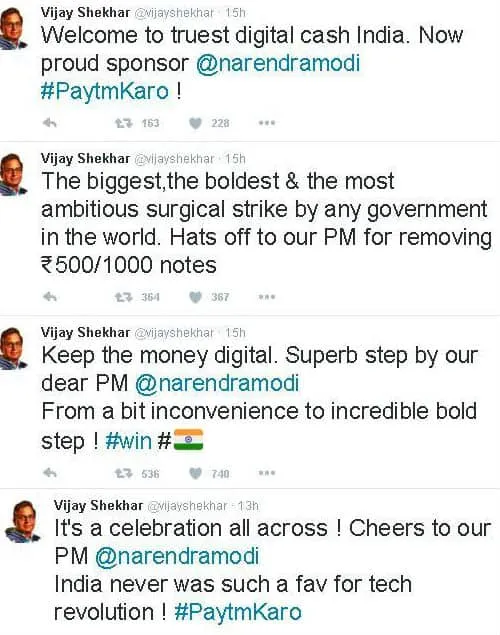
Why Paytm Karo is not an option for every Indian

The latest advertisement by Paytm which urges people to use their wallet service is nothing but a mockery of the Indian economic system. According to the advertisement, the domestic help is more conscious than the middle-class woman. I am wondering why brands get out of touch with the reality. We all know that demonetisation is hurting the common people and not the rich who have access to credit and debit cards. Also, unlike the common man this class purchases from high-end supermarkets and not the neighboring grocery shop. We don’t have a clear picture of how many small shopkeepers have access to Paytm wallet and accept money through that medium.
Social media marketing rests on driving mileage by hitting the right keynote which the public wants to hear. At times, the strategy hits the bullseye while sometimes it generates negative publicity. Ironically, in the Paytm case, the harsh reality of the Indian economic system has been twisted and misinterpreted to accommodate the advertisers’ message.
PaytmTwitter
Paytm karo
I am certainly not against the cashless system but such arrangement takes some time to settle itself amidst the masses. According to the World Bank, only 50 percent of the world’s population aged 15 years or older have an account at a formal financial institution and the majority of the “unbanked” live in developing countries.
Cash Vs cashless transaction
According to a RBI report published in March this year and entitled Concept Paper on Card Acceptance Infrastructure, ATM withdrawals account for 90 percent of the total volume of debit cards transactions and approximately 95 percent of the total value. Between October 2013 and October 2015, the number of POS terminals increased by 28 percent whereas the number of ATMs grew by around 43 percent.
Numerous consumer payment surveys have shown that cash is widely used for low-value transactions. According to Guillaume Lepecq, CEO, AGIS Consulting, “In the U.S., according to the 2015 Diary of Consumer Payment Choice, cash continues to be the most often used consumer payment instrument and dominates small-value transactions.”
“In 2015, 32 percent of consumer transactions were made with cash, compared with 40 percent in 2012. Growing consumer comfort with payment cards and the growth of online commerce, among other factors, has contributed to this trend. However, a broad range of results suggests that cash remains resilient and continues to play a key and unique role for consumers,” he added.
According to the same report, 90 percent of cash transactions were made for buying food and personal care supplies, auto and vehicle-related, general merchandise, and gifts and transfers to people.
Who drives the cashless agenda?
The drive towards cashless economies is driven by commercial banks and private payment service providers rather than governments or central banks. In Sweden, for example, the exercise has been driven by the two major commercial banks, which are closing down ATMs and denying cash services at branches, making it more expensive and burdensome to get hold of cash. But recently the central bank has declared that these banks have gone too far and is calling for a debate in Parliament on the minimum level of cash services banks should offer.
PaytmTwitter
Make hay while the sun shines.
Card acceptance rate in India has increased considerably, thanks to the availability of card readers and QR scanners at merchant outlets. However, despite high levels of card acceptance, consumers continue to use cash for small-value transactions.
So, in my opinion, India is not ready for “Paytm Karo”, until and unless every merchant outlet, big or small, accepts such service. Cash gives us security, the peace of mind which is not the case with the digital wallets.
PaytmTwitter
And it backfired…
In this digital age, where social media is transforming consumers’ perception of privacy, where big data is leading to the monetization of consumer information, the space for anonymity is gradually shrinking. In this context, cash is the last frontier for anonymous but regulated transactions.
For Paytm’s drama, I will quote Aerosmith’s song, “Dream on, dream on, dream on, dream until your dreams come true.”
                                      source: pcquest
Amazon Best Reads