Showing posts with label social. Show all posts

Facebook Messenger just beat Snapchat at its own game-- TECHNOLOGY HANDLER


Your Facebook Messenger conversations are about to undergo a big visual upgrade and it even has new features that aren’t available on Snapchat just yet.
“Messenger is becoming more real-time and more visual,” explained Stan Chudnovsky, head of product for Facebook Messenger, who noted that emoji and the in-app camera are outpacing overall text message growth. “We looked at that and figured, ‘Why don’t we go all the way?’”
Meet the latest Messenger update, which begins rolling out to smartphones today. It’s mostly been in the hands of employees and influencers designing stickers, but TechRadar was able to spend an afternoon playing around with the new app at Facebook’s Los Angeles office.
There’s a prominent camera button right inside the otherwise familiar iOS and Android chat app, making it easy to snap a photo or record a video. You can then add the sort of stickers, emoji, text, drawings and special effects that Snapchat has popularized. It’s almost all here.

One way Messenger beats Snapchat

Here is what’s really different: Facebook Messenger allows you to reverse the order of operations. Start with a “blank” canvas by throwing the same art into the camera viewfinder, then snap your photo when every sticker is lined up just how you like it.
You can perfectly position yourself behind all of that visual flair in a way that’s more efficient and fun than it is on Snapchat right now. Sure, Snap debuted four new features for its app this week, but it doesn’t have this one – and it’s important.
I posed in front of this classically drawn white coffee mug sticker, for example, having already placed it where I wanted it in the camera first. It was much easier to then arrange myself around the perfectly placed mug, and it allowed me to focus on making a stupid face. This is a better way of telling my friends “I’m working today and require coffee this very minute.”
Then I set up another photo by effortlessly ducking my head underneath a bunch of light rays (no, not stink lines, thanks), telling friends I was at Facebook LA today. The Messenger team intended to make these visual messages expressive and fast, and this does just that.

Brings AOL Instant Messenger ‘Away Messages’ into 2017

Remember AOL Instant Messenger’s away messages? Facebook is bringing that idea back with today’s update thanks to its own unique take on expiring visual messages.
“That was how I’d look at my buddy list,” said Peter Martinazzi, Director of Product Management for Facebook Messenger, recalling way too many sad and lyric-filled AIM away messages. “I’d see what my friends were up to at the time, and then I would message them based on that. This was a really big part of the chat experience.”
Today’s Messenger update is finally bringing a chat status that’s separate from your Facebook status – said to be a long-awaited feature for users – and it too is undergoing a visual retooling. It’s called ‘Your Story’ and it answers that same ‘what are you up to?’ question by allowing you to string together your visually enhanced messages for your friends to see.‘
Your Stories’ expire after 24 hours, just like Snapchat and Instagram’s similar ‘Stories,’ but this one is meant to be seen by your friends. That’s why the AIM away message analogy actually works. In fact, Messenger’s version of Stories appear at the top of the main chat menu, but it’s mainly populated with people you interact with – not every single friend. Even if you reach Facebook’s 5,000 friends limit, the most people that will see ever your stories is 500.
Update: The status message portion of Messenger of the update won't launch everywhere right away, but Facebook said it's rolling out over time.

Facebook’s two big advantages

“It’s less about the volume of people, and more about the right people – the ones you’re already talking to and those conversations get better,” noted Martinazzi, explaining how Messenger’s Stories are different from those seen on Snapchat.
Facebook knows who your friends are more than any other service. ‘Your Stories’ is sorted by the friends you interact with on Messenger and, to a smaller extent, Facebook. That’s currently a huge advantage for the service over something like Snapchat.
There’s also the fact that Messenger is a more straightforward chat app with a familiar user interface (UI). In addition to being used by one billion people a month, Messenger is now seeing hundreds of millions of users everyday, according to the Facebook team.
Messenger is in more hands and the app design is easier to use for non-millennials. That means it has a better chance of taking snaps mainstream. If I ever intend to pry my parents off of SMS and iMessages, I can introduced them to Messenger. I can’t imagine teaching them Snapchat.

For those missing the point: the birthday card analogy

Not everyone knows why they would want to create a visual message to get their point across, but Facebook’s Peter Martinazzi had a great analogy for when it works, likening it to a receiving a personalized birthday card.
“I actually don’t buy birthday cards,” admitted Martinazzi. “But my aunt still buys me birthday cards and when she does, she could just write me a message that says ‘Happy Birthday’ but she goes and picks out the perfect card for me.
“That helps her get her message across,” said Martinazzi. “Right now, the way emoji works, it’s like giving that blank card.
“With the camera, you can kind of put your name behind it.”

Instagram launches disappearing Live video and messages

Instagram launches disappearing Live video and messages

Instagram is combining the best of Snapchat and Periscope to help you get comfortable on camera. Rather than overlap with Facebook Live and Messenger, Instagram is putting an ephemeral spin on video streaming and private messaging.
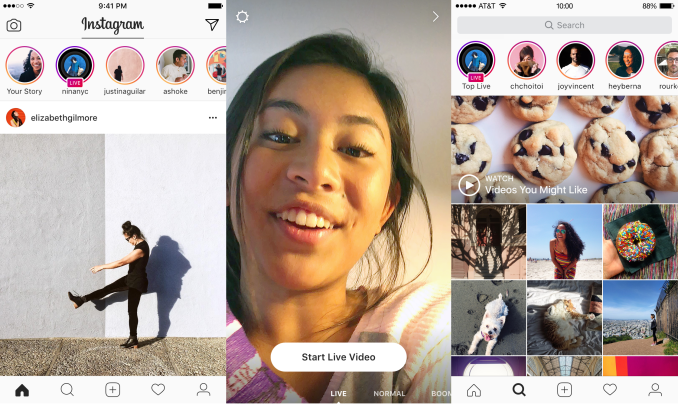
Today, two big new features begin rolling out to Instagram Stories on iOS and Android over the next few weeks. Instagram Live lets you broadcast video to your followers in real-time, but they can only watch while you’re still streaming. No replays. But you will be able to browse an algorithmically curated Explore page of the best Instagram Live videos happening right now.
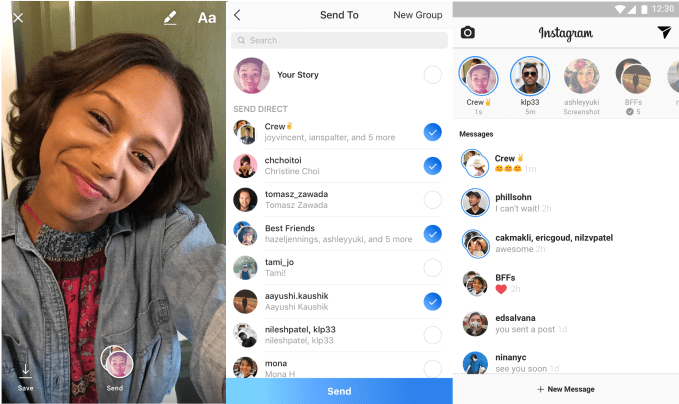
And if you don’t feel like sharing a doodle and text-covered Instagram Stories post to all your followers, you’ll be able to send it as a ephemeral Direct message to just a few of your closest friends. But they can only watch it twice before it disappears.
“We pivoted” Instagram’s head of product Kevin Weil tells me. “Instagram should be all of your moments, not just your highlights.” Since the new Live and Direct content self-destructs, Instagram hopes users will be less concerned about how they look or if they’re doing something cool. The features sway the balance of who Instagram is for further towards users rather than public figures and polished social media celebrities — a balance other apps get wrong.

Instagram Live

Instagram Live is the most ephemeral of the major Live streaming platforms now that Meerkat is defunct.
While Periscope started with a 24 hour expiration date, it eventually allowed permanent replays like Facebook Live. Instagram Live videos disappear as soon as the stream stops, which could get people broadcasting more frequently rather than saving the capability just for big flashy events or citizen journalism. Meanwhile, viewers will feel greater urgency to watch immediately because they know it’s their only chance.
Product manager Shilpa Sarkar tells me her company was “interested in people going live to hang out with friends.”, which is becoming popular in Live group video chat app Houseparty. Instagram was spotted testing Live in Russia by T Journal last month, and last week told The Verge it would build a Live product.
ig-live
See friends who are Live atop your feed, start your own broadcast, or discover the top Live streams in Explore
To go Live, you’ll swipe from the Instagram Stories camera. Instagram will choose some close friends who’ve shown interest in Live video to hit with notifications to come watch, as well as showing a Live tag on your Instagram Stories bubble that appears at the top of the feeds of your followers. Not alerting everyone who follows you prevents notification overload that plagued Periscope early on.
Viewers can comment, or tap repeatedly to add hearts exactly like on Periscope but with their face in some of the hearts. Broadcasters can add comments too, and helpfully pin one of theirs or a viewer’s to the top of the reel. For a more peaceful, FaceTimey experience, streamers can hide comments or all the buttons, and they can block or report anyone who harasses them.
Since none of your friends might be Live at any given moment, Instagram’s Explore tab Stories section will highlight the best Live streams happening now. Based on view count, geography, and language, Instagram will provide a curated channel you can swipe through, creating the most laid-back Live discovery and consumption experience around.

Instagram Direct Ephemeral

Instagram Direct already has 300 million monthly users, but all of the messages are permanent. The existing product lets you send text, photos, and videos, and posts from Instagram to friends and discuss them. But with Instagram Stories now letting you communicate visually with overlaid text and drawing, Instagram needed a way to share these ‘Gramsterpieces privately.
Now Direct will have an ephemeral Stories messages bar at the top along with a list of permanent threads below. When you go to share a photo or video to Instagram Stories, you’ll be able to also select friends or groups of friends to send it to. It’s much like how you can send Snapchat Stories as private messages, but adds in a groups feature.
instagram-direct-ephemeral
Shoot something in Instagram Stories, pick friends to Direct message it to, and they can watch before the content disappears
Recipients can watch the messages once, and replay them once, but then they’re gone. This way if you want to make a racy joke or share something vulnerable not fit for your public Story or all your friends, you can send it Direct and be sure it will disappear. If lots of friends contribute to one of these group “camera conversations”, the thread becomes sort of a collaborative Story slideshow you can tap through, reminiscent of the cooperative video app Riff that Facebook tried building.
The dual Direct inbox is certainly a bit complicated, but both ephemeral and permanent messaging makes sense in Instagram so it needed a way to collect both. A third option could be coming. When I asked if Instagram would ever let you Direct Live stream privately to a group of friends, the company said that makes sense and it’s thinking about how to do it. However, Instagram needs to be careful that it doesn’t become confusing with so many features.
What’s special about Instagram’s ephemeral Live and Direct updates is that they give creators total control over their audience. You see if someone starts watching your Live stream, and they can’t watch it later, while you select exactly who receives your Directs. That means no one can snoop on this content without you knowing immediately, something not even Snapchat offers for public accounts.
Typically, every piece of social media we create comes with the sneaking suspicion that a co-worker or family member might see it. That forces creativity to bend to the lowest common moral and intimacy denominator. Everything has to be inoffensive and guarded enough for everybody. But that extinguishes the true potential of Instagram unlocked by these features: the freedom to be yourself by choosing who you be yourself around.
                                                      source: tech crunch

LinkedIn is now officially blocked in Russia- Technology Handler


Amid a tense stand-off and attempt at negotiations, Russia’s communications regulator Roskomnadzor has started to enforce a proposed block of LinkedIn in the country, after the social network failed to transfer Russian user data to servers located in the country, violating a law instituted in Russia requiring all online sites to store personal data on national servers.
The order against LinkedIn was issued in a short statement on Roskomnadzor’s site (in Russian) — flagged to us by reader Ilya Pestov, CMO at Statsbot — that cited the original Moscow District Court decision from August to block LinkedIn, along with the more recent case from November 10, in a Moscow City Court, to uphold that decision.
LinkedIn has confirmed the block to us in a statement:
“LinkedIn’s vision is to create economic opportunity for the entire global workforce. We are starting to hear from members in Russia that they can no longer access LinkedIn,” said a spokesperson. “Roskomnadzor’s action to block LinkedIn denies access to the millions of members we have in Russia and the companies that use LinkedIn to grow their businesses. We remain interested in a meeting with Roskomnadzor to discuss their data localization request.”
The ban comes after LinkedIn — which is currently being acquired by Microsoft for $26.2 billion, although that deal is seeing some of its own regulatory hiccups — tried to meet with Russian regulators on Friday, November 11, in a last-minute attempt to hold off the ban, which will see ISPs in Russia forced to comply with the block in coming hours or else face heavy fines and potentially blocks of their own.
The statement they gave us last week, combined with what we know today, seems to imply that LinkedIn never got that meeting.
“LinkedIn’s vision is to create economic opportunity for the entire global workforce,” a spokesperson told TechCrunch last week. “The Russian court’s decision has the potential to deny access to LinkedIn for the millions of members we have in Russia and the companies that use LinkedIn to grow their businesses. We have on Friday (11 Nov) again requested a meeting with Roskomnadzor to discuss their data localization request and we understand they are reviewing this proposal at the present time.”
It’s not clear if LinkedIn hoped to buy more time to comply with the ruling, or if they were hoping to somehow negotiate an exception to the law. (We’ve asked, and will update if and when we get a reply.)
There is a precedent for LinkedIn choosing to comply and perhaps asking for more time. When LinkedIn launched in China, it did so by building essentially a completely separate site, with data hosted within the country, in order to meet similar regulatory requirements. Others that have done this include Evernote.


From what we understand, although there are a number of international sites accessible in Russia today, not all of them are hosting data within the country.
It’s not clear why LinkedIn — which has out of its 467 million users only 5 million registered in Russia — was targeted in this case. Some have speculated that it was a warning to bigger sites to be on their guard.
Russia has described its rule on localized servers as a way of protecting user’s personal data, although many dispute this reasoning, claiming that Russia simply wants an easier route to access that data for itself.
Data and the hacking of it is, in a way, shaping up to be the next cold war frontier. Russia has been implicated in a number of high-profile hacking cases, such as the recent breach of Democratic National Committee servers. Those investigations are still ongoing. Meanwhile, countries like the U.S. and U.K. are redoubling their efforts to build up their expertise and security both in response to the wave of breaches, but also perhaps to better arm themselves as aggressors.
Facebook and Twitter, both accessible in Russia, are among those that today appear still to keep their data housed out of RussiaApple and Google reportedly have complied.
And, as is often the case with these blocks, if you are in the country and use a VPN service that essentially makes you look like you’re online in another country, you can continue to use LinkedIn and anything else that is or might get blocked.
                                          source: techcrunch

New WhatsApp Update Brings Video Calling on Board

WhatsApp has finally merged into the queue of applications offering Video calling. What is the difference? Video calling is now integrated into the favourite messaging app of over a billion users worldwide. WhatsApp also has almost 160 million India users, making India a market of dominance.
Facebook-owned WhatsApp also has almost 160 million India users, making India a market of dominance. Therefore, WhatsApp’s video calling is enhanced for usage on the cellular network, keeping in consideration the connectivity bottleneck in the country. Following the launch in India today i.e. 15th November, Whatsapp video calling feature will be rolled out 180 countries around the globe.
Video calling, akin to WhatsApp text messages, will be encrypted end-to-end. While WhatsApp had introduced this feature on a Beta Testing update, the feature will find a home in all Android, iOS, and Windows devices gradually over a few hours of the launch event in India.
whatsapp video callingFor making video calls via WhatsApp, you must update to the latest version of WhatsApp. Once installed, touch the familiar handset button which will present separate options for Voice & Video Calls. The prevailing call appears like the tradition Picture-in-picture view.
Whatsapp was a late runner in the race to introduce voice calling or even end-to-end encryption. While video calling apps like Skype, Facetime, Google Hangouts have existed for a long time, what is interesting to observe that WhatsApp is deep-rooted in our lives. How well a function of added convenience aggregate to our current favourite messaging app.

                                                 source: pcquest

Google and Facebook ban fake news sites from their advertising networks

click here


While it would have been nice to tackle this issue before the election, Google and Facebook are finally taking a tiny step in order to fight back against fake news. According to multiple statements, both companies have updated their policies to ban fake news sites from using Facebook’s and Google’s advertising networks.
With the U.S. election, fake news became incredibly popular on social networks, such as Facebook, Twitter and YouTube, as well as news aggregating services, such as Google News and news articles in Google search results. We’re not talking about opinion articles — we’re talking about reports spreading blatantly inaccurate information.
Google first updated its policy saying that the company will try to ban sites that “misrepresent, misstate, or conceal information.” Websites who don’t comply with this rule will get banned from using Google AdSense.
When it comes to Facebook, the company has also updated its policy to rule out fake news sites from using Facebook Audience Network.
Google AdSense and Facebook Audience Network let content publishers display ads on their websites. Google and Facebook manage the ad inventories, content publishers get a cut for clicks or impressions.
Both companies already have strict policies for their ad networks. For instance, you can’t use Google AdSense on a porn website. Google uses a combination of algorithms and human moderation to decide whether a site is eligible to use its advertising service.
By removing a potential revenue stream, it makes the business of fake news a bit less lucrative. For instance, Buzzfeed discovered that more than 100 fake news sites were created in a tiny city in Macedonia. So it’s clear that it’s not just about influencing the election — people are taking advantage of social networks to make money using fake news.
But there will always be alternative revenue streams, so this move is not enough. Reducing the reach of these websites is the best way to prevent fake news sites from popping out. If Facebook, Twitter, Google News and other websites flagged fake news appropriately, then there would be no reason to create fake news sites in the first place.

Why Paytm Karo is not an option for every Indian

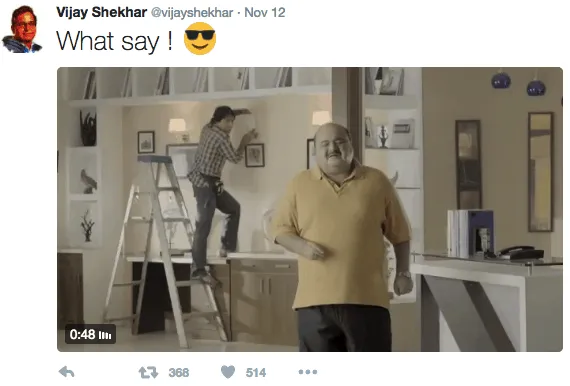
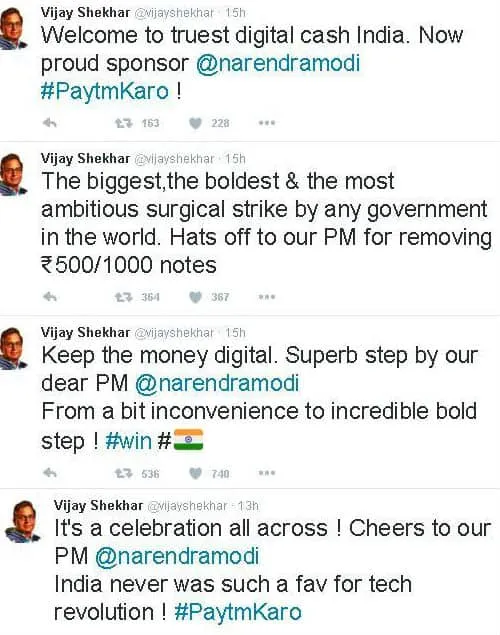
The latest advertisement by Paytm which urges people to use their wallet service is nothing but a mockery of the Indian economic system. According to the advertisement, the domestic help is more conscious than the middle-class woman. I am wondering why brands get out of touch with the reality. We all know that demonetisation is hurting the common people and not the rich who have access to credit and debit cards. Also, unlike the common man this class purchases from high-end supermarkets and not the neighboring grocery shop. We don’t have a clear picture of how many small shopkeepers have access to Paytm wallet and accept money through that medium.
Social media marketing rests on driving mileage by hitting the right keynote which the public wants to hear. At times, the strategy hits the bullseye while sometimes it generates negative publicity. Ironically, in the Paytm case, the harsh reality of the Indian economic system has been twisted and misinterpreted to accommodate the advertisers’ message.
PaytmTwitter
Paytm karo
I am certainly not against the cashless system but such arrangement takes some time to settle itself amidst the masses. According to the World Bank, only 50 percent of the world’s population aged 15 years or older have an account at a formal financial institution and the majority of the “unbanked” live in developing countries.
Cash Vs cashless transaction
According to a RBI report published in March this year and entitled Concept Paper on Card Acceptance Infrastructure, ATM withdrawals account for 90 percent of the total volume of debit cards transactions and approximately 95 percent of the total value. Between October 2013 and October 2015, the number of POS terminals increased by 28 percent whereas the number of ATMs grew by around 43 percent.
Numerous consumer payment surveys have shown that cash is widely used for low-value transactions. According to Guillaume Lepecq, CEO, AGIS Consulting, “In the U.S., according to the 2015 Diary of Consumer Payment Choice, cash continues to be the most often used consumer payment instrument and dominates small-value transactions.”
“In 2015, 32 percent of consumer transactions were made with cash, compared with 40 percent in 2012. Growing consumer comfort with payment cards and the growth of online commerce, among other factors, has contributed to this trend. However, a broad range of results suggests that cash remains resilient and continues to play a key and unique role for consumers,” he added.
According to the same report, 90 percent of cash transactions were made for buying food and personal care supplies, auto and vehicle-related, general merchandise, and gifts and transfers to people.
Who drives the cashless agenda?
The drive towards cashless economies is driven by commercial banks and private payment service providers rather than governments or central banks. In Sweden, for example, the exercise has been driven by the two major commercial banks, which are closing down ATMs and denying cash services at branches, making it more expensive and burdensome to get hold of cash. But recently the central bank has declared that these banks have gone too far and is calling for a debate in Parliament on the minimum level of cash services banks should offer.
PaytmTwitter
Make hay while the sun shines.
Card acceptance rate in India has increased considerably, thanks to the availability of card readers and QR scanners at merchant outlets. However, despite high levels of card acceptance, consumers continue to use cash for small-value transactions.
So, in my opinion, India is not ready for “Paytm Karo”, until and unless every merchant outlet, big or small, accepts such service. Cash gives us security, the peace of mind which is not the case with the digital wallets.
PaytmTwitter
And it backfired…
In this digital age, where social media is transforming consumers’ perception of privacy, where big data is leading to the monetization of consumer information, the space for anonymity is gradually shrinking. In this context, cash is the last frontier for anonymous but regulated transactions.
For Paytm’s drama, I will quote Aerosmith’s song, “Dream on, dream on, dream on, dream until your dreams come true.”
                                      source: pcquest

Facebook admits it must do more to stop the spread of misinformation on its platform

Facebook admits it must do more to stop the spread of misinformation on its platform

Facebook has responded to widespread criticism of how its Newsfeed algorithm disseminates and amplifies misinformation in the wake of the Trump victory in the US presidential election yesterday.
Multiple commentators were quick to point a finger of blame at Facebook’s role in the election campaign, arguing the tech giant has been hugely irresponsible given the role its platform now plays as a major media source, and specifically by enabling bogus stories to proliferate — many examples of which were seen to circulated in the Facebook Newsfeed during the campaign.
Last week Buzzfeed reported on an entire cottage industry of web users in Macedonia generating fake news stories related to Trump vs Clinton in order to inject them into Facebook’s Newsfeed as a way to drive viral views and generate ad revenue from lucrative US eyeballs.
This enterprise has apparently been wildly successful for the teens involved, with some apparently managing to pull in up to $3,000 and $5,000 per month thanks to the power of Facebook’s amplification algorithm.
That’s a pretty hefty economic incentive to game an algorithm.

In a statement sent to TechCrunch responding to a series of questions we put to the company (see below for what we asked), Adam Mosseri, VP of product management at Facebook, conceded the company does need to do more to tackle this problem — although he did not give any indication of how it plans to address the issue.As TC’s Sarah Perez wrote yesterday, the social network has become “an outsize player in crafting our understanding of the events that take place around us”.
Here’s his statement in full:
We take misinformation on Facebook very seriously. We value authentic communication, and hear consistently from those who use Facebook that they prefer not to see misinformation. In Newsfeed we use various signals based on community feedback to determine which posts are likely to contain inaccurate information, and reduce their distribution. In Trending we look at a variety of signals to help make sure the topics being shown are reflective of real-world events, and take additional steps to prevent false or misleading content from appearing. Despite these efforts we understand there’s so much more we need to do, and that is why it’s important that we keep improving our ability to detect misinformation. We’re committed to continuing to work on this issue and improve the experiences on our platform.
Facebook has previously been criticized for firing the human editors it used to employ to curate its trending news section. The replacement algorithm it switched to was quickly shown to be trivially easy to fool.
Yet the company continues to self-define as a technology platform, deliberately eschewing wider editorial responsibility for the content its algorithms distribute, in favor of applying a narrow and universal set of community standards and/or trying to find engineering solutions to filter the Newsfeed. An increasingly irresponsible position, given Facebook’s increasingly powerful position as a source of and amplifier of ‘news’ (or, as it sometimes turns out to be, propaganda clickbait).
Pew research earlier this year found that a majority of U.S. adults (62 per cent) now get news via social media. And while Facebook is not the only social media outfit in town, nor the only where fake news can spread (see also: Twitter), it is by far the dominant such platform player in the US and in many other markets.
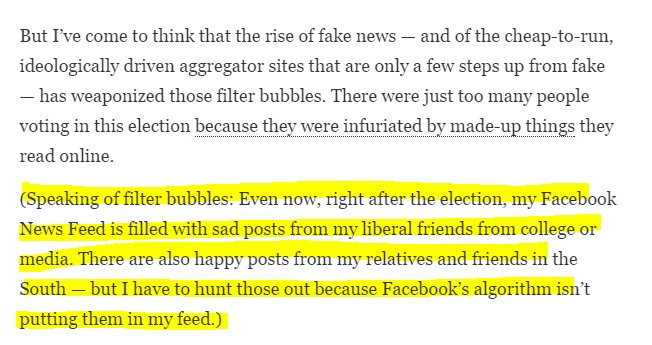
Beyond literal fake news spread via Facebook’s click-hungry platform, the wider issue is the filter bubble its preference-fed Newsfeed algorithms use to encircle individuals as they work to spoonfeed them more clicks — and thus keep users spinning inside concentric circles of opinion, unexposed to alternative points of view.
That’s clearly very bad for empathy, diversity and for a cohesive society.
The filter bubble has been a much discussed concern — for multiple years — but the consequences of algorithmically denuding the spectrum of available opinion, whilst simultaneously cranking open the Overton window along the axis of an individual’s own particular viewpoint, are perhaps becoming increasingly apparent this year, as social divisions seem to loom larger, noisier and uglier than in recent memory — at very least as played out on social media.
We know the medium is the message. And on social media we know the message is inherently personal. So letting algorithms manage and control what is often highly emotive messaging makes it look rather like there’s a very large tech giant asleep at the wheel.
Questions we put to Facebook:
  • How does Facebook respond to criticism of its Newsfeed algorithm amplifying fake news during the US election, thereby contributing negatively to misinformation campaigns and ultimately helping drive support for Donald Trump’s election?
  • Does Facebook have a specific response to Buzzfeed’s investigation of websites in Macedonia being used to generate large numbers of fake news stories that were placed into the Newsfeed?
  • What steps will Facebook be taking to prevent fake news being amplified and propagated on its platform in future?
  • Does the company accept any responsibility for the propagation of fake news via its platform?
  • Will Facebook be reversing its position and hiring human editors and journalists to prevent the trivial gaming of its news algorithms?
  • Does Facebook accept that as increasing numbers of people use its platform as a main news source it has a civic duty to accept editorial responsibility for the content it is broadcasting?
  • Any general comment from Facebook on Trump’s election?
                                                                                      source: TechCrunch
Amazon Best Reads